Bitcoin mining comprises of both hashing24, and block verification and
production. The economics of Bitcoin mining have both economies and
diseconomies of scale.25 These economies and diseconomies of scale act as
centralizing and decentralizing pressures24.
The primary diseconomy of scale is the fact that Bitcoin hashing consumes
energy and produces heat. Opportunities to obtain cheap energy, and to dispose
of or make use of waste heat, have inherent diseconomies of scale due to the
fact that the cheapest energy production is inherently spread out across the
globe24. For example, flare gas and stranded/surplus renewable energy are some of
the cheapest sources of energy available. Obviously, opportunities to collect
flare gas and renewable energy are inherently spread across the globe. This is
a diseconomy of scale25 because the maximum size of these operations is limited
by the available energy at any one location. A oil well that generates 100KW of
free waste flare gas in a given location simply can’t generate more free waste
gas at any reasonable price.
Similarly, some hashing operations make use of their waste heat, eg to heat
buildings. Obviously, the amount of waste heat that any one location can make
use of is inherently limited. Again, this acts as a diseconomy of scale25: a
house that can be sufficiently heated with 50KW of hash power simply has no use
for more hash power in that location.
Grid stabilization is another example of a diseconomy of scale. Some Bitcoin
hashing operations have been able to get credits on their electricity bills for
providing the ability to quickly reduce their power usage. Obviously, the
maximum amount of grid stabilization needed in any one geographic area is
limited, creating a diseconomy of scale25.
Response 26The primary economies of scale are in mining pools. They exist because of
variance: with just 144 Bitcoin blocks generated per day, the average Bitcoin
hashing operation mining blocks directly for themselves (solo-mining) would
need to wait months or even years between payments. Secondly, the operating
costs of a mining pool are mostly fixed: the bandwidth and compute power needed
per hashing operation is almost zero. If the overhead costs of operating the
necessary nodes is non-trivial, there is a significant savings for a large pool
compared to a small pool as that overhead is spread over more clients.
Thus we see that while Bitcoin hashing is quite decentralized — with a very
large number of individual hashing operations in existence — the number of
Bitcoin mining pools is much more limited24. At the time of writing, the majority
of hash power is spread over just two pools:
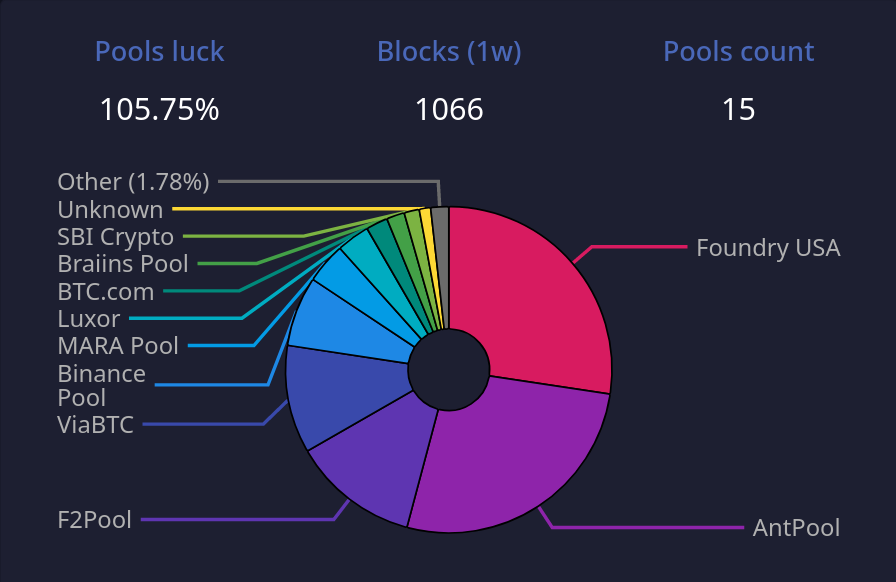
While undesirable, this situation isn’t fatal as, in theory, bad behavior can
cause hashing operations to quickly switch from one pool to another.
Additionally, there are technologies like
StratumV224,
p2pool27, and
braidpool
that decentralize block production (mining).27
Response 28While we don’t have space to go into details about these technologies, the
important thing in the context of drivechains is that they all require hashing
operations to produce blocks themselves, requiring them to run full nodes.